Hilltop Urban Farm Conservation Project
Let’s Conserve Urban Green Space & Preserve the Hilltop Urban Farm!
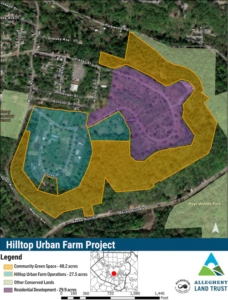
SUMMARY | Allegheny Land Trust is collaborating with community partners to conserve an urban hillside forest and the Hilltop Urban Farm (HUF) land in the City of Pittsburgh’s St. Clair neighborhood. This project’s completion would permanently protect a beloved community farm that serves as an asset to those who enjoy close-to-home opportunities for growing food, gathering with neighbors, learning about agriculture, and exploring entrepreneurial ventures.
SITE HISTORY (source) | In the 1950s, this land transformed from a farm, lush with apple orchards, into St. Clair Village, a federal housing project sheltering 1,089 families. By 2010, however, the neighborhood hemorrhaged 80% of its population, leaving behind a stark 65% vacancy rate and crumbling concrete.
Today, the land is host to the Hilltop Urban Farm. The vision sprouted from the community’s desire to breathe new life into neglected land. Strategic partnerships resulted in a community-informed plan for permanent green space and an urban farm at the site. More than 3,000 volunteers attended 100+ volunteer events to help implement various stages of the site plan. Today, the farm is operating on land that does not yet have the promise of permanence.
A majority of the 12 Hilltop communities have median household incomes of < 75% of the City of Pittsburgh’s median. St. Clair and 8 other Hilltop neighborhoods meet the federal USDA definition of a food desert. In the 2020 FeedPGH Report, the St. Clair neighborhood is identified as a Healthy Food Priority Area.
In the face of these challenges, HUF is already delivering measurable impact. In 2025, HUF donated over 8,700 pounds of produce and 163 pounds of orchard fruit, served 3 food pantries and 1 farmer’s market, and provided direct access to food + educational programming to 2,000 individuals.
Today, after years of community input, stakeholder planning, collaboration with local leadership, and successful implementation, ALT is working to acquire and permanently protect the forested hillside and farmland to secure the future of this transformed community asset.
BENEFITS | Conserving this urban forest and farm would provide stability for continued investment in the surrounding community, allow for expanded programming and food production at the farm, support the absorption of more than 61 million gallons of stormwater and 200,000 pounds of carbon annually, and much more.
HUF already provides many benefits to the surrounding community; protecting the land would cement these benefits (source):
- Youth Farm — A living ecological laboratory where local school children play, learn, and interact amongst raised beds bursting with fresh produce, in gardens designed for curious young explorers, and in an orchard that doubles as a food forest. It’s a delicious education in nutrition, a hands-on masterclass in urban ecology, and a glimpse into the vast possibilities of agricultural careers.
- Farmer Incubation Program — Providing for-profit urban farming startups regenerated urban farming acres, solar power, hoop houses, mobile coolers, and a shared tool library. It’s not just about growing crops: it’s about growing a new generation of food producers. The impact? They’ve quadrupled the amount of fresh produce grown in Pittsburgh.
- Urban Orchards — From the soft fuzz of apricots to the gnarled wisdom of fig trees, from the clustered bounty of hazelnuts to the exotic charm of Asian pears, the commercial orchard of 175 fruit and nut trees is a nod to the forest that once blanketed this landscape. Those 52 cider apple trees? They’re not just about bringing back a lost local crop; they’re about fermenting new economic opportunities with local breweries. And don’t forget the restoration chestnut trees – silent sentinels that whisper tales of the vast forests that once cloaked these hills.
- Local Fresh Produce Distribution — Farmers market and food bank partnerships ensure that fresh produce reaches those who need it most. It’s a direct assault on neighborhood-based food insecurity.
- Soil Restoration — Hilltop Urban Farm faced significant soil remediation challenges when transforming the former St. Clair Village housing project land into a productive agricultural space. As the site was developed, the compacted soil left behind from the previous buildings and low organic matter content common in Pittsburgh’s urban soils was addressed. Soil was rebuilt with compost and cover crops to make it suitable for growing food. This foundational work was essential for converting the former residential development into what has become one of America’s largest urban farms.
STATUS & FUNDING | ALT is convening the many county, city, and neighborhood partners that have shepherded this project to complete its transformation into a permanently protected asset this year. A total of $1,520,000 is needed to permanently conserve the land. In collaboration with HUF, ALT has already secured 68% of those funds and has a multi-pronged plan to raise the remaining funds from local foundations, corporations, and individuals in the community.
HOW YOU CAN HELP | We need your help! Community members are a critical component of the funding puzzle as they help to meet state grant matching requirements, as well as close any funding gaps. A full funding plan will soon be formed and shared on this page. We hope you’ll support this project to help protect this unique urban farm and forest forever!